
Messenger in the Valley
But it will rain, and you will feel the gratitude of having been found.

This was written in the monsoon of 2014. If rains come this weekend, they will make you miserable. This essay is to torment you, the littlest much, through contrast.
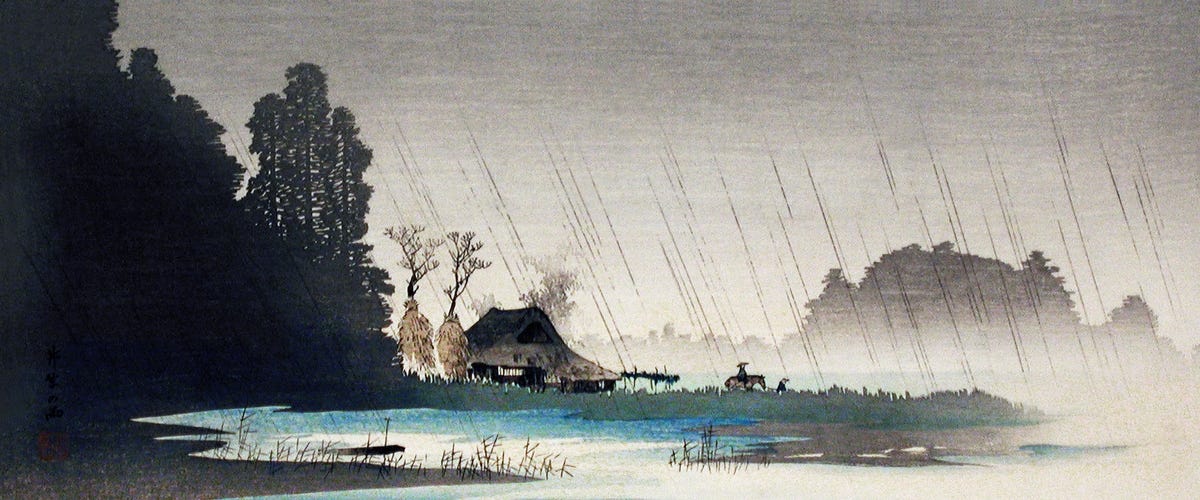
Rain is differently disruptive in a village: if you are indoors, you are trapped there. If you are in the fields, you must run to the nearest fig or mango or jackfruit tree and wait in the shade. If the rain comes in slowly, the earth hisses and rises as fragrant vapors. If it comes hard, it pits the dirt and makes large, wet dents. If it clears within minutes, stopping as if to hurriedly deliver a message sent by a distant lover, the skies open and the greens of the forests become a different set of greens, the blues of the sky a different set of blues. Mulch darkens. Dust whipped up by sun and wind gets between your toes as mud. Irrigation canals and streams change their voices. A crow will patiently take the beatings of the rain, refusing to fly away on its heavy, soggy wings. Dogs bark if the horizon flashes with lightning. The rumble of thunder measuring its way from the eastern end of the valley to the western end passes over your house, and reaches in to shake everything just a little, nudging your heart slightly to the left. Then it ambles away to tease your friend in the next house, and the pretty girl in the next village over by the river, until it passes right out of the valley. If it rains for days on end the walls of your house become damp and birds will not sing in the evening to remind you that kaphal pakyo in the forest. The frog behind your house croaks until you get tired of listening to it, until you get tired of watching the gecko guard the light bulb in its patient wait for moths. Rain can fall sideways and slantways, or it can dance on the palms of the wind that shakes and whirls it every which way. Sometimes, it can bring hailstones, some the size of peas, some the size of marbles, but once a year come hailstones so big they bullet right through slates on the roof and break open earthen pickle-jars, letting loose the smell of mustard oil and fermented radish and turmeric. Rain can puddle in the kitchen garden and wait for the neighbor’s ducks to file in. If there is maize in the fields the tattoo of rain on maize leaves sounds like an army marching toward a grand feast in a fairytale land. If you squat by a rice paddy, you hear the last drops of rain plop into the water, like a frog heading home to its family after sunning itself through an afternoon. If these are the first days of monsoon everybody rushes about to prepare to harvest its bounty. If this is the second month of monsoon, the air is thick with the odor of fecundity and fields smell of fish and fertility. By the third month there is too much mud and mosquito and rain is no longer relief from the summer sun. Even the green of healthy crops appears oppressive. Eyes grow fatigued at the surfeit of green, and begin to crave the gold of ripeness, the brown spot of decay that comes with maturity. And, just like that, the lumbering giants of cumulus atop the mountains forget to surprise you: they watch ever westward, hypnotized by the fiery ball that, before its daily fall, paints them copper and molten bronze. Sometimes flocks of sheep cross the blue sky. But the sullen, dark messenger dispatched by Kalidas so many centuries ago no longer stops by your village. Pity – when it comes next, you will have become a different person. When it comes next, you will be living in a city, glued to the windowpane, the taste of the iron grille on the window a faint reminder of the hiss of steam rising from the red soil of your village. Rain falls in the city on windows, roofs, asphalt streets, dog shit, a cart of rotting tomatoes, the clear plastic dome of a neighbor’s umbrella, cactus in a flowerpot; of all things possible – cactus in a flowerpot. It falls on plastic tarps and buckets out spasmodically on passersby. It falls on movie posters and garbage heaps – and as you watch over a weekend away from school, purple, brown and green leaves shoot out of mango stones and wait for the garbage truck to take them away, far away, to a landfill site. If rain in the city doesn’t fall from slanted roofs, it gurgles down grey gutter pipes and disappears. Only when the rivers swell from being veins of sewage to gushing, writhing bodies of murky water does the rain really show itself. The hills regain their dye of green, but they are distant, and there are too many barriers in between. Here, too, the cumulus giants lumber through September and October, but you are trapped in a quiet hall, nodding as you try to memorize lessons in tandem with eighty other boys. When the clouds call you out again, you will be far away – a foreigner, in a foreign land. You are in a desert. It doesn’t rain here. There are no hills. But all is green around you. Children here play under the spray of garden sprinklers. It rains a few days before you leave that city – it rains for three hours, and it is a warm rain, just like the rain in your village, but nobody comes out to play, except three children who run back and forth between their porch and the street, squealing as they get soaked. When it rains again, you have been back in your city for three whole months – the worst, infernal months punctuated with heartbreak and apathy – and you have been waiting for a shift in the wind, for some respite. Then, sometime in June, the skies rumble. Your nephew, who runs down the stairs to his grandfather’s bed each time he hears thunder, finds you strange, perhaps even terrifying, as you step out to the wide balcony to sniff at the sulfur in the air. Like pink neon lettering hurtling over the valley, lightning stretches endlessly, crackles as blue whiplash. A drop of rain falls on your shoulder and soaks into the shirt, grows outward. It will rain. Not like it did in the village of your childhood, not like it rained in the school with football pitches full of mud, not like it did – as if a private message to you – in the foreign desert. But it will rain, and you will feel the gratitude of having been found.
—
Prawin Adhikari is a writer, translator and editor. He is the author of Budhani (2025), Folk Gods (2019) and The Vanishing Act (2014). He has also translated Han Kang’s The Vegetarian into Nepali. He recently translated Narayan Wagle’s Koreana - Coffee Guff into English.
 | A guest post by
|